





Have you ever written a message and stopped for a moment because you were unsure whether to write “happend” or “happened”? This small spelling question can confuse students, English learners, bloggers, and even people who use English every day.
- Happend or Happened: Which One Is Correct? ✅
- What Does Happened Mean? 📖
- Happened Definition in Simple English
- How Do You Spell Happened?
- Why Do People Write Happend Instead of Happened?
- The Origin and History of Happened
- American English vs British English Spelling
- The Grammar Rule Behind Happened
- Happened Pronunciation
- Happened Examples in Everyday English
- Difference Between Happen, Happens, and Happened
- Happened vs Happening
- Common Spelling Mistakes With Happened
- Which Spelling Should You Use?
- Happened in Emails and Professional Writing
- Happened in News and Everyday Conversations
- Happened Synonyms: Other Words You Can Use
- Happened Meaning in Other Languages
- When to Use “What Happened?” and “What Happens?”
- Did It Happen or Did It Happened?
- What Has Happened?
- Happened to Meaning: Common Expressions
- Happened Upon Meaning
- Happen vs Occur: What Is the Difference?
- Simple Tips to Remember the Correct Spelling
- Final Thoughts
- FAQs About Happend or Happened
The two forms look almost the same. When people speak quickly, the difference can also be difficult to notice. As a result, many writers accidentally leave out a letter when typing an email, writing a social media post, or explaining something that happened in the past.
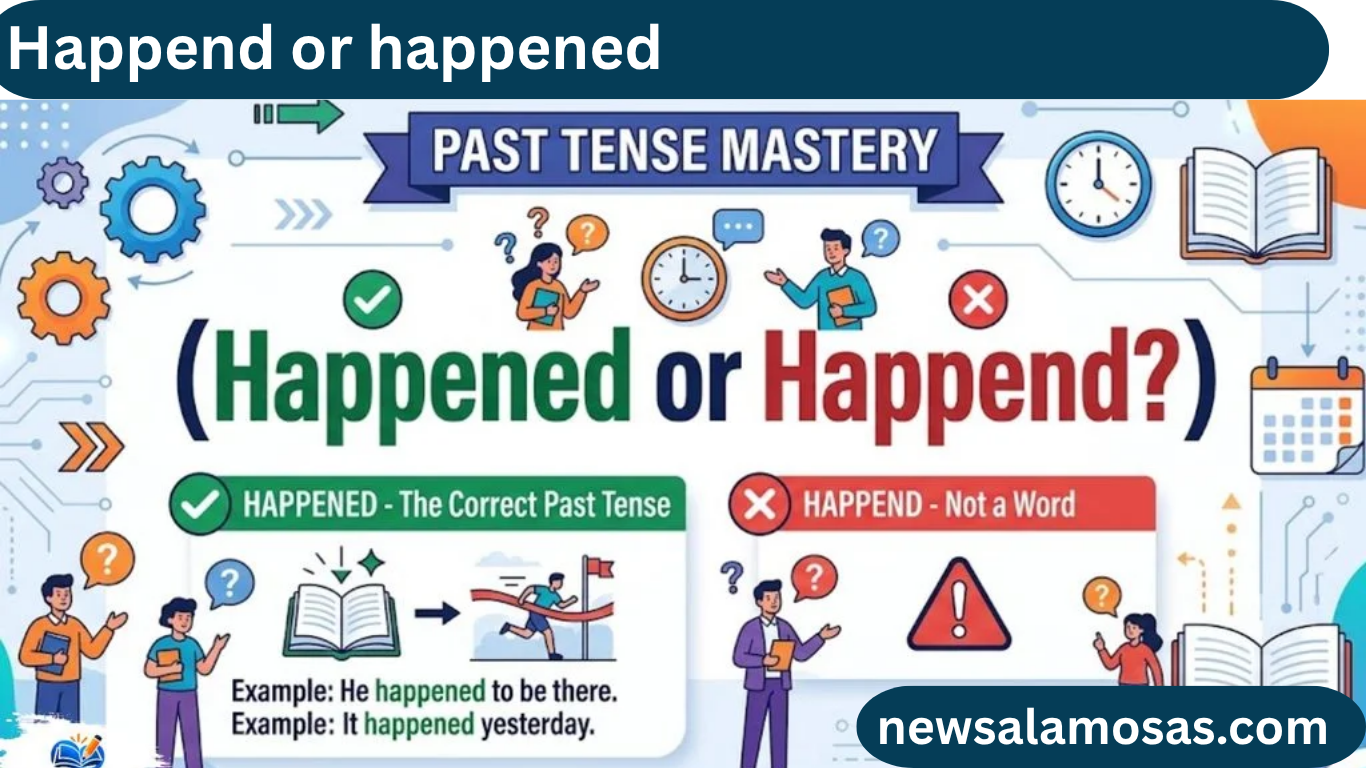
The correct spelling is “happened.” The word “happend” is a common spelling mistake and should not be used in standard English writing.
However, understanding this word involves more than remembering its spelling. You also need to know the difference between “happen,” “happens,” “happened,” and “happening.” Each form has a different purpose in a sentence.
In this guide, you will learn the meaning of happened, the correct spelling, its pronunciation, the past tense rule, and how to use it in everyday English. You will also find simple examples, common grammar mistakes, alternative words, and answers to frequently asked questions.
Happend or Happened: Which One Is Correct? ✅
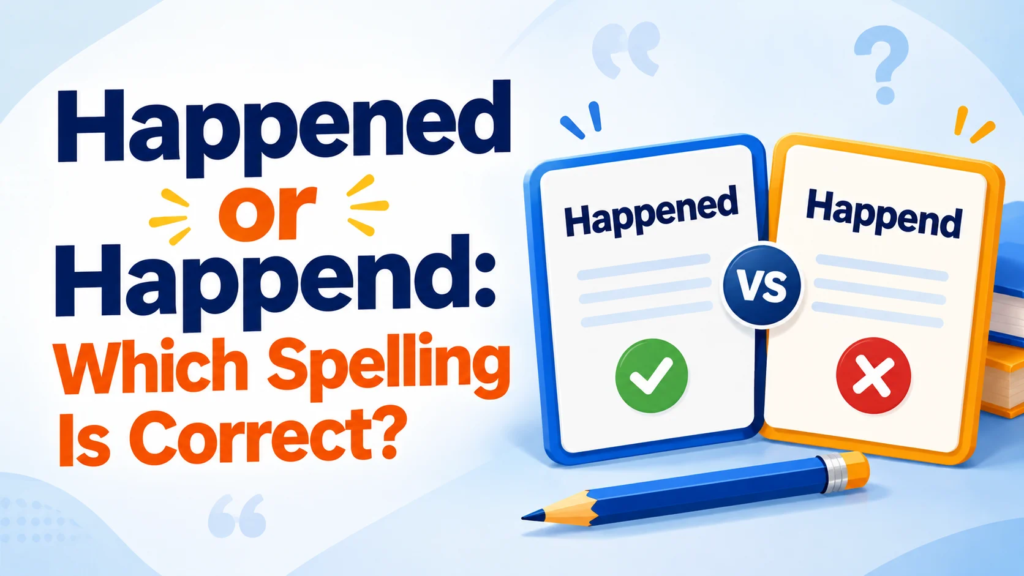
The correct spelling is happened.
“Happend” is incorrect because it leaves out the letter “e” that appears before the final “d” in the standard past-tense form.
Here is a simple comparison:



| Word | Correct or Incorrect | Meaning |
| Happened | Correct | Past tense of happen |
| Happend | Incorrect | Common misspelling of happened |
| Happen | Correct | Base form of the verb |
| Happens | Correct | Present-tense form used with singular subjects |
| Happening | Correct | The act of taking place or occurring |
For example, you should write:
“Something unexpected happened yesterday.”
You should not write:
“Something unexpected happend yesterday.”
The difference is only one letter, but using the correct spelling makes your writing clearer and more professional.
Also read:How Streamlining Financial Processes Enhances Your Financial Operations Platform
Whenever you are unsure whether to write “happend or happened,” choose “happened” if you are talking about an event that took place in the past.
What Does Happened Mean? 📖
“Happened” is the simple past tense and past participle of the verb “happen.” It means that something took place, occurred, or came about.
The word can describe many kinds of events. It can refer to an accident, a meeting, a personal experience, a change, an unexpected situation, or an ordinary event.
For example:
“The meeting happened yesterday.”
This means the meeting took place yesterday.
“Something unusual happened at school.”
This means an unusual event occurred at school.
“I don’t know what happened.”
This means the speaker does not know what took place.
The word is common in everyday American English because people regularly use it to explain events and experiences.
Happened Definition in Simple English
The easiest definition of “happened” is that something occurred or took place in the past.
For example, if a phone stopped working yesterday, you might say, “My phone stopped working yesterday.” You could also explain the situation by saying, “Something happened to my phone yesterday.”
Both sentences describe a past situation.
The word does not always explain exactly what occurred. Sometimes, it simply tells the listener that an event took place.
Consider these examples:
“Something happened during the trip.”
“What happened after the meeting?”
“The problem happened without warning.”
“The change happened over several months.”
In each sentence, “happened” refers to an event or situation connected to the past.
How Do You Spell Happened?
The correct spelling is:
H-A-P-P-E-N-E-D
Happened.
One useful way to remember the spelling is to begin with the base verb “happen” and add the regular past-tense ending “-ed.”
Happen + ed = Happened
The base word contains two “p” letters. The past form keeps those letters and adds “ed” to the end.
This gives you the correct spelling:
Happen → Happened
A common mistake is to write “happend” because the middle vowel is not always clearly heard in normal speech. However, the written form still requires the “e” before the final “d.”
If you are writing an essay, email, article, school assignment, or professional document, always use “happened.”
Why Do People Write Happend Instead of Happened?
There are several reasons why people make this mistake.
First, English pronunciation does not always make every written letter easy to recognize. When people say “happened” quickly, the middle vowel can sound weak.
Second, people often type according to how a word sounds rather than how it is spelled. This can lead to small errors, especially when writing quickly.
Third, the word “happen” already ends in “en.” Some writers may forget that the past form requires the full “-ed” ending.
For example:
Happen → Happened
Not:
Happen → Happend
The best solution is to remember the complete past form instead of trying to spell it only by sound.
The Origin and History of Happened
The word “happen” developed in English from earlier forms associated with events, chance, and what comes about. Over time, its meaning became widely used for anything that takes place or occurs.
Today, the verb has a broad meaning. It can describe something planned, something unexpected, or an event that occurs as part of everyday life.
For example:
“The concert happened on Saturday.”
“The accident happened in the afternoon.”
“Something interesting happened during the discussion.”
The word can describe both ordinary and unusual events.
The past form “happened” follows the regular English pattern of adding “-ed” to a verb. This is why the standard spelling is “happened,” rather than “happend.”
American English vs British English Spelling
Some English words have different spellings in American and British English. For example, American English commonly uses “color,” while British English uses “colour.” Similarly, “center” is common in the United States, while “centre” is common in British English.
However, “happened” does not change its spelling between these varieties of English.
| English Variety | Correct Spelling | Example |
| American English | Happened | The event happened yesterday. |
| British English | Happened | The meeting happened earlier. |
| Australian English | Happened | Something unexpected happened. |
| Incorrect spelling | Happend | Not standard English |
The correct form remains “happened” regardless of where you use English.
This makes the word easier to learn because you do not need to remember separate American and British spellings.
The Grammar Rule Behind Happened
“Happened” is formed from the base verb “happen” by adding the regular past-tense ending “-ed.”
Many English verbs follow the same general pattern.
| Base Verb | Past Tense |
| Open | Opened |
| Listen | Listened |
| Clean | Cleaned |
| Visit | Visited |
| Happen | Happened |
The base word “happen” already contains two “p” letters. Those letters remain in the past form, and the word gains the ending “-ed.”
It is important not to confuse this with spelling rules that double a final consonant in certain verbs, such as “stop” becoming “stopped.”
With “happen,” the spelling is simply:
Happen + ed = Happened
Remembering this pattern can help you avoid the common mistake of writing “happend.”
Happened Pronunciation
The word “happened” is commonly pronounced approximately as “HAP-und” in everyday American English.
Its pronunciation is often represented as /ˈhæpənd/.
The first syllable receives the main stress, while the second syllable is usually unstressed.
Because the second vowel is weak in ordinary speech, some people may not clearly hear the “e” in the written word. This can make “happend” look like a reasonable spelling to someone who is learning English.
However, pronunciation and spelling are not always identical in English.
The best way to remember the correct form is to connect the pronunciation with the written word:
Happened = H-A-P-P-E-N-E-D.
Happened Examples in Everyday English
The word “happened” appears in many situations. It can be used when describing something that occurred at home, at school, at work, during travel, or in a public place.
Here are some simple examples.
“The power went out last night.”
“Something strange happened during the trip.”
“The meeting happened earlier than expected.”
“I forgot what happened after lunch.”
“The accident happened near the intersection.”
“Nothing unusual happened during the weekend.”
These examples show that “happened” does not need to describe a major event. It can refer to almost anything that took place in the past.
Difference Between Happen, Happens, and Happened
“Happen,” “happens,” and “happened” come from the same verb, but they are used in different grammatical situations.
| Word | Usage | Example |
| Happen | Base form, including after modal verbs | Things can happen. |
| Happens | Present tense with a singular third-person subject | It happens every year. |
| Happened | Past tense | It happened last year. |
When to Use Happen
Use “happen” after modal verbs such as “will,” “can,” “could,” “may,” and “might.”
Examples:
“What will happen next?”
“Accidents can happen.”
“What might happen tomorrow?”
“Anything could happen.”
You also use “happen” in the base form after “do” and “did” in questions and negatives.
For example:
“Did anything happen?”
“I didn’t know what would happen.”
When to Use Happens
Use “happens” with a singular third-person subject in the simple present tense.
Examples:
“It happens every summer.”
“This happens quite often.”
“Something unusual happens every year.”
The word describes a general situation, a repeated event, or something that occurs regularly.
When to Use Happened
Use “happened” when talking about an event in the past.
Examples:
“The event happened last week.”
“The problem happened during the update.”
“What happened yesterday?”
Understanding these three forms will help you write correct sentences without confusing the spelling or tense.
Happened vs Happening
“Happened” describes a past event, while “happening” is used for an event that is taking place or developing.
For example:
“The accident happened yesterday.”
“The accident is happening now.”
The first sentence describes a past event. The second describes an event in progress.
Here are more examples:
“Something unexpected happened at work.”
“Something unexpected is happening at work.”
“The changes happened last year.”
“The changes are happening now.”
When you want to describe something that is taking place at the present moment, “happening” is usually the correct form.
Common Spelling Mistakes With Happened
Several incorrect spellings appear when people try to write the past form of “happen.”
| Incorrect Spelling | Correct Spelling |
| Happend | Happened |
| Happenned | Happened |
| Happenend | Happened |
| Hapened | Happened |
| Happended | Happened |
These mistakes may happen because people forget a letter, add an extra letter, or misunderstand the way regular past-tense verbs are formed.
The easiest way to avoid these errors is to memorize the word as a complete spelling.
You can also use spell-check tools in writing applications. However, learning the correct form is still useful because automatic spelling tools may not catch every error in every situation.
Which Spelling Should You Use?
If you are choosing between “happend” and “happened,” use “happened” when you need the past tense of “happen.”
For example:
Correct: “The package happened to arrive early.”
Incorrect: “The package happend to arrive early.”
Correct: “What happened at the office?”
Incorrect: “What happend at the office?”
Correct: “It happened several years ago.”
Incorrect: “It happend several years ago.”
There is no standard American or British spelling rule that makes “happend” correct. In ordinary writing, it should be treated as a spelling error.
Happened in Emails and Professional Writing
Correct spelling is important in professional communication because it helps readers understand your message without distraction.
For example, imagine you are explaining a delay to a coworker. You might write:
“The delay happened because the delivery arrived late.”
Or you could use a slightly more formal alternative:
“The delay occurred because the delivery arrived late.”
Both sentences communicate the same basic idea.
In professional emails, reports, and workplace messages, use “happened” when describing a past event. If you need a more formal tone, “occurred” may be a suitable alternative.
The goal is not to use complicated words. It is to choose words that communicate your meaning clearly.
Happened in News and Everyday Conversations
The word “happened” is also common in news reports and conversations.
For example:
“The incident happened early this morning.”
“What happened during the game?”
“The event happened in the city center.”
“What happened after the announcement?”
In everyday conversation, “What happened?” is one of the most natural ways to ask someone to explain a past event.
You might use it when someone looks upset, when plans change unexpectedly, or when you want to understand a situation.
Also read:How Ba Insight Alfresco Integration Enhances Enterprise Content Management?
The word works in both casual and formal contexts because its meaning is direct and easy to understand.
Happened Synonyms: Other Words You Can Use
Sometimes, another word may fit your sentence better than “happened.”
Common alternatives include “occurred,” “took place,” “transpired,” “unfolded,” and “came about.”
| Alternative | Example |
| Occurred | The incident occurred yesterday. |
| Took place | The meeting took place on Monday. |
| Transpired | Nobody knew what had transpired. |
| Unfolded | The situation unfolded quickly. |
| Came about | The change came about gradually. |
These words are related, but they are not always perfect replacements.
“Occurred” is common in formal and technical writing. “Took place” often works well for planned events. “Transpired” can sound formal or literary. “Unfolded” often describes a process or developing situation.
Choose the word that best fits the meaning and tone of your sentence.
Happened Meaning in Other Languages
People learning English may also search for the translation of “happened” in another language.
The exact translation depends on the sentence, tense, and context. A word that works in one sentence may not be the best choice in another.
For example:
| Language | Possible Translation |
| Spanish | Ocurrió |
| French | Est arrivé / s’est produit |
| Urdu | ہوا |
| Hindi | हुआ |
These are common translations for the idea of something occurring in the past, but they may change depending on the subject and sentence structure.
If you are translating a complete sentence, it is better to translate the meaning rather than replace “happened” with a single word in every situation.
When to Use “What Happened?” and “What Happens?”
These two questions look similar, but they refer to different time frames.
“What happened?” asks about a past event.
“What happens?” usually asks about a general situation, repeated event, or process.
Compare these examples:
“What happened after the meeting?”
This asks about a specific event in the past.
“What happens after the meeting?”
This asks what normally takes place after a meeting.
Similarly:
“What happened when you pressed the button?”
“What happens when you press the button?”
The first asks about a particular past experience. The second asks about the usual result.
Did It Happen or Did It Happened?
The correct sentence is “Did it happen?”
When “did” is used to form a question about the past, the main verb stays in its base form.
Correct: “Did anything happen?”
Incorrect: “Did anything happened?”
Correct: “Why did this happen?”
Incorrect: “Why did this happened?”
This is an important rule because people sometimes think that every past-tense question needs a past-tense main verb. In English, “did” already shows the past tense, so the main verb returns to its base form.
Remember this pattern:
Did + happen
Not:
Did + happened
What Has Happened?
“What has happened?” is another common English question.
It uses the present perfect structure, which connects a past event to the present situation.
For example:
“What has happened to the computer?”
“Do you know what has happened?”
“What has happened since our last meeting?”
The structure is:
Has + happened
For example, “It has happened before” is correct.
You should not write “It has happend before” or “It has happen before.”
Learning the correct form helps you avoid mistakes in questions, explanations, and longer sentences.
Happened to Meaning: Common Expressions
The phrase “happened to” can be used in several ways.
One common use is to ask what occurred to someone or something.
For example:
“What happened to your phone?”
“What happened to the original plan?”
“What happened to the package?”
Another use describes something that occurred by chance.
For example:
“I happened to see my neighbor at the store.”
This means the speaker saw the neighbor unexpectedly or by chance.
“She happened to be nearby.”
This means she was nearby, perhaps unexpectedly.
The meaning depends on the sentence, so it is helpful to consider the words around the phrase.
Happened Upon Meaning
“Happened upon” means to find, discover, or encounter something by chance.
For example:
“I happened upon an old photograph while cleaning.”
This means the speaker found the photograph unexpectedly.
“She happened upon an interesting book.”
This means she came across the book by chance.
“They happened upon a quiet restaurant during their trip.”
This means they discovered the restaurant without necessarily planning to find it.
Also read:Digital Marketing Strategies: Effective Approaches for AEO vs GEO Decisions
The phrase is less common than “found” or “came across,” but it remains useful in written English.
Happen vs Occur: What Is the Difference?
“Happen” and “occur” have similar meanings. Both can describe something taking place.
For example:
“The problem happened yesterday.”
“The problem occurred yesterday.”
Both sentences are understandable and grammatically correct.
However, “happen” is more common in everyday conversation, while “occur” often sounds more formal.
You might ask a friend, “What happened?”
In a report, you might write, “The incident occurred during the afternoon.”
The best choice depends on the situation and the tone you want to create.
Simple Tips to Remember the Correct Spelling
If you often confuse “happend” and “happened,” a few simple habits can help.
First, remember the base form: “happen.”
Next, add “-ed” to make the past form: “happened.”
Finally, practice the word in a complete sentence instead of memorizing the spelling alone.
For example:
“It happened yesterday.”
“What happened next?”
“Something unusual happened.”
Reading these sentences aloud and writing them a few times can help you remember the correct form.
You can also use a spell-checker while editing longer documents. Over time, regular reading and writing practice will make the correct spelling easier to recognize.
Final Thoughts
The difference between “happend” and “happened” is simple once you understand the spelling rule.
“Happened” is the correct past tense and past participle of “happen.” It describes something that took place or occurred in the past. “Happend” is a common misspelling and should not be used in standard English writing.
Remember the basic word forms:
Happen — base form.
Happens — present tense with a singular third-person subject.
Happened — past tense and past participle.
Happening — an event in progress.
The examples are easy to remember: “Things happen,” “It happens every year,” “It happened yesterday,” and “It is happening now.”
Also remember that “did” is followed by the base form of the verb. That is why “Did it happen?” is correct, while “Did it happened?” is incorrect.
Once you understand these patterns, you can write “happened” confidently in messages, emails, school assignments, articles, and professional documents.
FAQs About Happend or Happened
Is it spelled happend or happened?
The correct spelling is “happened.” The word “happend” is a misspelling. For example, write “The meeting happened yesterday,” not “The meeting happend yesterday.”
What is the past tense of happen?
The past tense of “happen” is “happened.” For example, “Something happened last night.” It is also used as the past participle in sentences such as “It has happened before.”
Why is “happend” incorrect?
“Happend” is incorrect because it does not follow the standard spelling of the past form of “happen.” The correct form is created by adding “-ed” to “happen,” resulting in “happened.”
Should I write “did happen” or “did happened”?
Use “did happen” when forming a question or adding emphasis with “did.” For example, “Did anything happen?” is correct. “Did anything happened?” is incorrect because “did” already marks the past tense.
What is the difference between happened and happening?
“Happened” describes an event that took place in the past, while “happening” describes an event that is taking place or developing. For example, “It happened yesterday” refers to the past, while “It is happening now” describes an event in progress.