






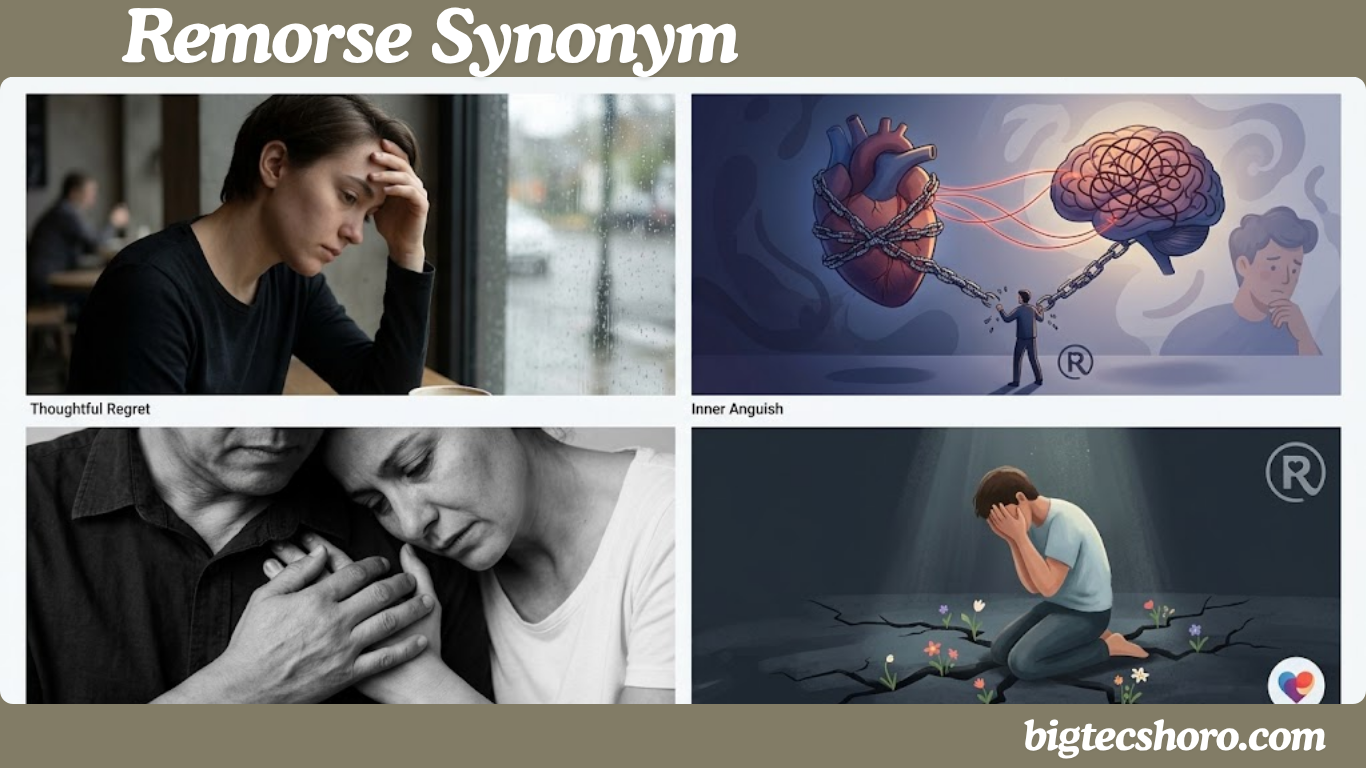

The word remorse describes a profound emotional burden. At its core, the definition of remorse centers on deep personal grief, sorrow, and mental anguish caused by a sense of guilt over past actions. When you search for the meaning of remorse in English, dictionary sources describe it as an intense form of moral regret.
- Remorse vs. Regret vs. Guilt: Key Differences
- Master List: 100 Synonyms for Remorse
- Group 1: Common Everyday Synonyms (Direct & Natural)
- Group 2: Formal, Literary, and Legal Synonyms
- Group 3: Strong Emotional Distress and Anguish Words
- Group 4: Action-Oriented Terms (Showing Remorse and Atonement)
- Group 5: Synonyms for “To Feel Remorse” (Verb Forms and Phrases)
- Group 6: Modifiers and Adjectival Alternatives (Remorseful Synonyms)
- Group 7: Situational and Nuanced Synonyms (Context-Specific)
- Group 8: Phrasal and Descriptive Equivalents
- Expressions Related to Remorse
- Antonyms: Opposite Words for Remorse
- Practical Usage and Examples in Sentences
- Daily Life and Personal Conversations
- Professional and Business Communication
- Legal, Legal, and Formal Contexts
- Common Pitfalls and Mistakes to Avoid
- Frequently Asked Questions (FAQs)
- What is the definition of remorseful in simple words?
- Are remorse and guilt synonyms or antonyms?
- What is the best synonym for remorse in everyday writing?
- Can you feel remorse without hurting another person?
- What does it mean when a judge says a defendant lacks remorse?
- What is the adjective form of remorse?
- Conclusion
It is not simply feeling bad because an outcome turned out poorly; it is the distressing realization that your own choices caused harm, wrong, or pain to someone else.
[ Past Action / Harm Done ]
│
▼
[ Realization of Fault & Hurt ]
│
▼


┌──────────────┴──────────────┐
▼ ▼
[ Casual Regret ] [ True Remorse ]
• “I missed the train.” • “I betrayed a friend.”
• Disappointment • Moral guilt & anguish
• Self-focused • Desire for atonement
To fully grasp what remorse means, it helps to break down its core elements:
- Recognition of Wrongdoing: Accepting that your words or actions were ethically or morally wrong.
- Empathy for the Victim: Focusing on the distress caused to another person rather than just your own uncomfortable situation.
- Desire for Atonement: Wanting to apologize, make amends, or change your future behavior to prevent repeating the mistake.
- Emotional Weight: Experiencing real distress, internal conflict, and mental strain rather than a minor, passing feeling.
In terms of grammar, the word remorse functions as an uncountable noun. Its adjective form is remorseful, which describes a person who actively feels or displays this deep guilt. The adverb form is remorsefully, and the state of being remorseful is sometimes referred to as remorsefulness.

Remorse vs. Regret vs. Guilt: Key Differences
People frequently treat remorse, regret, and guilt as exact synonyms. While they overlap, confusing these terms can weaken your writing and obscure your true meaning.
┌─────────────┬─────────────────────────────┬───────────────────────────────┐
│ Term │ Core Focus │ Example Context │
├─────────────┼─────────────────────────────┼───────────────────────────────┤
│ Regret │ Outcome / Personal Loss │ Regretting a missed flight │
│ Guilt │ Violation of Rule / Standard│ Feeling guilty for breaking a │
│ │ │ diet or traffic law │
│ Remorse │ Moral Impact on Others │ Sorrow for betraying a close │
│ │ │ friend’s trust │
└─────────────┴─────────────────────────────┴───────────────────────────────┘
Remorse vs. Regret
Regret is a broad, self-focused emotion. You can feel regret over choices that have nothing to do with morality or hurting others. For example, you might regret forgetting an umbrella on a rainy day or buying a sweater that goes on sale the following week.
Remorse, on the other hand, requires a moral dimension. It always involves self-reproach for a wrong act that hurt someone else or violated your own ethical code.
Also Read: Victoria Granucci: Complete Biography, Marriage to John Mellencamp, Children, and Life Today
Key Distinction: You can regret a bad investment, but you feel remorse for lying to a loved one.
Remorse vs. Guilt
Guilt is the recognition that you breached an ethical, legal, or social standard. It acts as an internal alarm telling you that you did something wrong.
Remorse goes a step further by adding deep emotional sorrow, personal responsibility, and a strong desire to fix the situation. Guilt acknowledges the broken rule; remorse grieves the hurt caused by breaking it.
Master List: 100 Synonyms for Remorse
When searching for another word for remorse or synonyms for remorseful feelings, selecting the precise word depends on your context and desired tone. Below are 100 genuinely relevant synonyms grouped by category, tone, and practical usage.
Group 1: Common Everyday Synonyms (Direct & Natural)
These terms work seamlessly across daily speech, general writing, and clear digital communication.
- Guilt: The basic internal feeling of having committed a wrong or broken a standard.
- Regret: A clear feeling of sadness or wish that past actions had been different.
- Contrition: Sincere, heartfelt sorrow for past misdeeds and a desire to make things right.
- Repentance: Active regret for past wrongs accompanied by a decision to reform behavior.
- Penitence: Deep sadness over wrongdoing, often paired with a willing acceptance of punishment or correction.
- Self-reproach: Blaming yourself directly for a mistake or harmful act.
- Shame: A painful emotion caused by consciousness of guilt, shortcoming, or improper behavior.
- Sorrow: Deep distress or grief caused by loss, disappointment, or personal fault.
- Self-blame: Assigning fault to yourself for an unfortunate or harmful outcome.
- Compunction: A sharp sting of conscience or hesitation before or after doing wrong.
Group 2: Formal, Literary, and Legal Synonyms
Use these expressions in legal briefs, academic essays, formal literature, or official press releases.
- Penitance: Formal state of feeling or showing regret for bad behavior.
- Ruefulness: Sorrowful regret mixed with a quiet realization of foolishness.
- Self-condemnation: The act of declaring yourself entirely guilty and worthy of blame.
- Moral anguish: Severe mental suffering caused by ethical conflict or wrongdoing.
- Self-accusation: Directing internal blame toward your own conduct.
- Chastened state: Feeling humbled, humbled, and corrected by guilty feelings.
- Bad conscience: Persistent internal discomfort resulting from unethical choices.
- Scruples: Internal hesitation or moral reluctance caused by guilt or conscience.
- Conscience-stricken: Overwhelmed by a sudden realization of guilt.
- Heartache: Deep, persistent emotional distress resulting from regretful actions.
Group 3: Strong Emotional Distress and Anguish Words
These terms capture severe, overwhelming internal suffering tied to remorseful feelings.
- Anguish: Extreme distress, severe torment, or agonizing pain of the mind.
- Torment: Intense mental suffering caused by relentless guilt.
- Agony: Intense, enduring emotional or psychological suffering.
- Grief: Deep sadness and mourning, specifically over lost trust or moral failure.
- Heartbreak: Overwhelming sorrow caused by severe regret or personal failure.
- Despair: Complete loss of peace caused by heavy, unaddressed guilt.
- Misery: A state of profound discomfort caused by persistent self-reproach.
- Mortification: Deep shame, humiliation, and emotional embarrassment over an act.
- Self-chastisement: Punishing yourself mentally for your misdeeds.
- Self-flagellation: Excessive or painful self-blame and ongoing guilt.
Group 4: Action-Oriented Terms (Showing Remorse and Atonement)
These synonyms describe the visible effort to make amends, seek forgiveness, or change direction.
- Atonement: Making amends or reparation for a wrong or injury caused.
- Redemption: Seeking salvation or clearing your record through positive change.
- Amends-making: Actively working to restore trust and fix damage.
- Expiation: The act of making amends or paying the penalty for guilt.
- Penance: An act performed to show sorrow for a sin or wrongdoing.
- Apology: A formal or informal expression of regret and admission of fault.
- Reconciliation: Seeking to repair a broken relationship after expressing sorrow.
- Restitution: Returning what was taken or repairing harm as an act of contrition.
- Self-correction: Adjusting your course of action after realizing a mistake.
- Reformation: Changing your behavior entirely as a result of deep regret.
Group 5: Synonyms for “To Feel Remorse” (Verb Forms and Phrases)
When you need a verb phrase to convey to feel remorse, these options fit naturally into various sentence structures:
- To rue: To bitterly regret a specific decision or action.
- To repent: To feel deep regret for past conduct and turn toward better choices.
- To lament: To express deep grief or sorrow over past actions.
- To deplore: To strongly regret or condemn a personal choice.
- To feel guilt: To carry an internal weight of responsibility for a wrong.
- To kick oneself: Informal phrase meaning to feel sharp self-reproach over a mistake.
- To feel conscience-stricken: To be suddenly overcome with moral sorrow.
- To bear a heavy heart: To carry persistent sadness and regret.
- To feel bad for: To experience sympathy and self-blame for hurting someone.
- To eat one’s heart out: To suffer quietly from bitter regret and shame.
- To feel the sting of conscience: To experience sharp moral discomfort.
- To hang one’s head: To show physical signs of shame and regret.
- To smart under guilt: To suffer mentally under the weight of wrongdoing.
- To feel contrite: To harbor an attitude of sincere, humble sorrow.
- To make peace with oneself: The process of dealing with internal regret.
Group 6: Modifiers and Adjectival Alternatives (Remorseful Synonyms)
Use these when describing a person, tone, or letter that shows remorse:
- Contrite: Feeling or showing sorrow and remorse for improper behavior.
- Repentant: Feeling or showing sorrow for wrongdoings with a desire to reform.
- Penitent: Feeling or showing sorrow and regret for having done wrong.
- Apologetic: Expressing regret or acknowledgment of failure.
- Guilt-ridden: Plagued, overwhelmed, or tormented by ongoing feelings of guilt.
- Self-reproachful: Expressing or feeling personal blame.
- Rueful: Expressing sorrow or regret, often in a quiet or slightly humorous way.
- Sorry: Feeling regret, sympathy, or sadness over an action.
- Conscience-smitten: Deeply affected by feelings of moral failure.
- Chastened: Humbled and restrained by a sense of error.
- Ashamed: Feeling shame, guilt, or embarrassment over conduct.
- Compunctious: Feeling a pricking of conscience or hesitant regret.
- Sorrowful: Full of deep sadness or grief.
- Remorseful: Filled with a deep, tormenting sense of guilt.
- Grief-stricken: Overwhelmed by deep emotional distress.
Group 7: Situational and Nuanced Synonyms (Context-Specific)
These terms match specific scenarios like financial regret, minor social slips, or intense internal conflict.
- Buyer’s remorse: Regret felt after making a significant purchase.
- Post-purchase regret: Practical anxiety or doubt following a financial decision.
- Post-decision dissonance: Psychological tension felt after committing to a choice.
- Social hangover: Discomfort or regret felt after awkward social interactions.
- Bitter regret: Intense, unpleasant disappointment over a past choice.
- Self-disappointment: Sadness caused by falling short of your own standards.
- Moral discomfort: Subtle, persistent unease regarding an ethical issue.
- Internal unrest: Lack of emotional peace caused by unresolved regret.
- Penitential distress: Emotional weight tied to seeking forgiveness.
- Self-indictment: Formally or mentally accusing oneself of wrongdoing.
- Moral sorrow: Grief experienced specifically because of ethical failure.
- Prick of conscience: A sudden, brief feeling of moral guilt.
- Qualm: A sudden feeling of doubt, worry, or fear, especially about conduct.
- Misgiving: A feeling of doubt, apprehension, or hesitation.
- Heavy conscience: A state of mind burdened by unresolved wrong.
Also Read:Synonyms for Pride: Meanings, Examples, and Complete Usage Guide
Group 8: Phrasal and Descriptive Equivalents
These descriptive expressions capture the feeling of remorse without using a single word:
- Full of self-blame: Carrying heavy personal responsibility for harm.
- Plagued by regret: Continuously bothered by past mistakes.
- Weighed down by guilt: Physically or mentally exhausted by moral failure.
- Haunted by past actions: Unable to escape memories of bad choices.
- Grieved by wrongdoing: Experiencing personal sorrow over past conduct.
- Stricken by conscience: Immobilized by sudden moral awareness.
- Humbled by error: Lowering one’s pride due to a clear mistake.
- Broken-hearted over harm: Experiencing emotional pain for hurting another.
- Burdened with fault: Carrying the ongoing weight of personal responsibility.
- Seeking forgiveness: Actively looking to clear guilt through reconciliation.
- Eager to make amends: Driven by regret to fix a broken situation.
- Troubled in spirit: Experiencing deep internal unrest over an action.
- Mourning a mistake: Expressing sadness over a bad decision.
- Sorrowful at heart: Holding genuine, deep regret internally.
- Desperate to correct: Feeling urgent remorse that demands immediate action.
Expressions Related to Remorse
To communicate effectively, you also need to know how to describe the presence, absence, or specific types of remorse.
┌──────────────────────────────────────────────┐
│ Remorse Spectrum │
└──────────────────────┬───────────────────────┘
│
┌────────────────────┼────────────────────┐
▼ ▼ ▼
[ Showing Remorse ] [ Lack of Remorse ] [ Buyer’s Remorse ]
• Contrite • Unrepentant • Financial regret
• Apologetic • Callous • Non-moral
• Making amends • Cold-hearted • Consumer focus
Showing Remorse
When someone actively displays sorrow for their actions, we say they are showing remorse or acting with remorse.
- Clear Synonyms: Expressing contrition, showing repentance, demonstrating guilt, displaying self-reproach.
- Context Example: “The defendant showed clear remorse during his statement, offering a sincere apology to the family.”
Lack of Remorse or Showing No Remorse
When an individual hurts others without feeling guilt or showing sorrow, they display a complete lack of remorse or act without remorse. This trait is often discussed in criminal justice and psychology.
- Clear Synonyms for Showing No Remorse: Unrepentant, callous, shameless, ruthless, cold-hearted, unfeeling, unremorseful, hardened, indifferent, brazen.
- Context Example: “The tribunal noted that the executive was completely unrepentant, showing no remorse for the financial damage caused to investors.”
Buyer’s Remorse
Buyer’s remorse is a unique long-tail phrase referring to post-purchase regret. Unlike true moral remorse, it does not involve hurting anyone; it is the psychological discomfort or anxiety felt after spending money on something you might not need or cannot afford.
- Clear Synonyms: Post-purchase regret, post-decision dissonance, shopper’s regret, purchasing anxiety.
- Context Example: “Shortly after signing the contract for the expensive sports car, he experienced severe buyer’s remorse.”
Antonyms: Opposite Words for Remorse
Understanding the opposite word of regret or remorse helps clarify its meaning by contrast. Antonyms generally fall into two categories: positive peace of mind or negative callousness.
┌─────────────────────────────────┬─────────────────────────────────┐
│ Positive Antonyms │ Negative Antonyms │
│ (Peace & Self-Satisfaction) │ (Callousness & Insensitivity) │
├─────────────────────────────────┼─────────────────────────────────┤
│ • Satisfaction │ • Impunity │
│ • Pride │ • Unrepentance │
│ • Clear conscience │ • Indifference │
│ • Peace of mind │ • Callousness │
│ • Self-approval │ • Obduracy │
└─────────────────────────────────┴─────────────────────────────────┘
Positive Antonyms (Peace and Clean Conscience)
- Satisfaction: Contentment with your past choices and their results.
- Pride: Pleasure and self-respect gained from acting honorably.
- Clear conscience: Freedom from feelings of guilt, shame, or self-reproach.
- Peace of mind: Emotional calm arising from ethical clarity.
- Self-approval: Satisfaction with your own conduct and decisions.
Negative Antonyms (Hardened or Unfeeling States)
- Impunity: Exemption or freedom from punishment and internal discomfort.
- Unrepentance: A complete refusal to feel sorry or reform behavior.
- Indifference: A total lack of concern or feeling regarding the impact of your actions.
- Callousness: Emotional hardness and disregard for the suffering of others.
- Obduracy: Persistent, stubborn refusal to change or feel regret.
Practical Usage and Examples in Sentences
To help you use these terms accurately, here are natural example sentences across different writing contexts:
Daily Life and Personal Conversations
- “After speaking harshly to his sister, he was filled with remorse and called to apologize.”
- “She felt genuine contrition for missing her best friend’s milestone birthday.”
- “He carried persistent guilt for months after breaking his promise.”
Professional and Business Communication
- “The company issued a public statement expressing deep regret for the service outage.”
- “The manager showed clear self-reproach after realizing his oversight caused the project deadline to fail.”
- “To avoid buyer’s remorse, always review your budget before making major purchases.”
Legal, Legal, and Formal Contexts
- “The judge reduced the sentence because the defendant demonstrated genuine remorse and cooperated with authorities.”
- “Her formal letter reflected true penitence and a firm commitment to make full financial restitution.”
- “The committee criticized the director’s callous indifference toward safety regulations.”
Common Pitfalls and Mistakes to Avoid
Also Read:100 Synonyms for Fearless: The Complete Vocabulary Guide for Writers
- Using “remorse” for trivial daily inconveniences:
- Incorrect: “I felt deep remorse for forgetting my umbrella today.”
- Correction: “I felt regret for forgetting my umbrella today.”
- Rule: Reserve remorse for situations involving personal responsibility, moral choices, or harm to others.
- Overusing heavy formal terms in casual conversations:
- Incorrect: “I feel deep penitence for dropping your pencil.”
- Correction: “I feel sorry for dropping your pencil.”
- Rule: Match the weight of the word to the seriousness of the situation. Use contrition or penitence in formal or serious settings, not lighthearted chats.
- Confusing “remorseful” with “reluctant”:
- Incorrect: “He was remorseful to sign the contract because he was busy.”
- Correction: “He was reluctant to sign the contract because he was busy.”
- Rule: Reluctant means hesitant; remorseful means feeling sorrow for past misdeeds.
Frequently Asked Questions (FAQs)
What is the definition of remorseful in simple words?
Being remorseful means feeling genuinely sorry, guilty, and distressed because you did something wrong or hurt someone else.
Are remorse and guilt synonyms or antonyms?
Remorse and guilt are synonyms. Both refer to negative feelings arising from bad behavior. However, remorse involves a deeper emotional sorrow and a stronger desire to repair the harm.
What is the best synonym for remorse in everyday writing?
The most natural everyday synonyms for remorse are guilt and deep regret. For formal writing, contrition is often the best choice.
Can you feel remorse without hurting another person?
Usually, remorse involves hurting another person or violating a shared trust. However, you can feel remorse for betraying your own personal values or ethics, even if no one else finds out.
What does it mean when a judge says a defendant lacks remorse?
It means the offender shows no sorrow, regret, or understanding of the pain they caused. A lack of remorse often leads to stricter legal penalties because it suggests the person may repeat the crime.
What is the adjective form of remorse?
The primary adjective form is remorseful. The opposite adjective is unremorseful or remorseless.
Conclusion
Understanding the synonyms for remorse helps you select the exact word needed to match your tone, context, and emotional depth. Whether you choose a simple everyday word like guilt, a formal term like contrition, or a specific phrase like buyer’s remorse, using these vocabulary options accurately will improve your writing and communication.