







Have you ever written “peaked my interest” and then wondered if the spelling was right?
- Piqued or Peaked: Which Is Correct?
- What Does Piqued Mean?
- Piqued Definition in Simple English
- What Does Pique Mean?
- Piqued My Interest: Meaning and Correct Usage
- Piqued or Peaked My Interest?
- Pique My Interest or Peak My Interest?
- Piques My Interest
- Piquing My Interest
- Piqued My Curiosity
- Pique Your Curiosity
- My Curiosity Is Piqued or Peaked?
- Curiosity Piqued or Peaked?
- My Interest Is Piqued or Peaked?
- My Interest Was Piqued
- My Interest Was Piqued When I Found Out
- What Piqued Your Interest?
- What Piques Your Interest?
- You’ve Piqued My Interest
- Piqued His Interest, Piqued Her Interest, and Piqued Their Interest
- Piqued or Peaked Interest
- Interest Has Peaked or Piqued?
- Peaked Definition
- What Does Peaked Mean?
- What Does It Mean to Peak?
- Peaking Definition
- Peak vs Peek
- Peek Meaning
- Peeked Meaning
- Peeked or Peaked?
- Peaking or Peeking?
- Sneak Peek or Sneak Peak?
- Take a Peek or Take a Peak?
- Peak Interest vs Pique Interest
- Pique vs Peak vs Peek
- Common Spelling Mistakes
- Piqued in Professional Writing
- Piqued in Academic Writing
- Peaked in Business and Data
- Piqued vs Peaked in a Sentence
- Piqued vs Peeked in a Sentence
- Another Word for Piqued
- Piqued My Interest Synonyms
- Piqued Pronunciation
- How Do You Spell Piqued?
- How Do You Spell Peaked?
- How Do You Spell Peek?
- A Quick Way to Choose the Right Word
- Final Thoughts
- FAQs About Piqued or Peaked
You are not alone. “Piqued” and “peaked” sound the same, so it is easy to mix them up when writing. The problem becomes even more confusing because “peeked” sounds the same too.
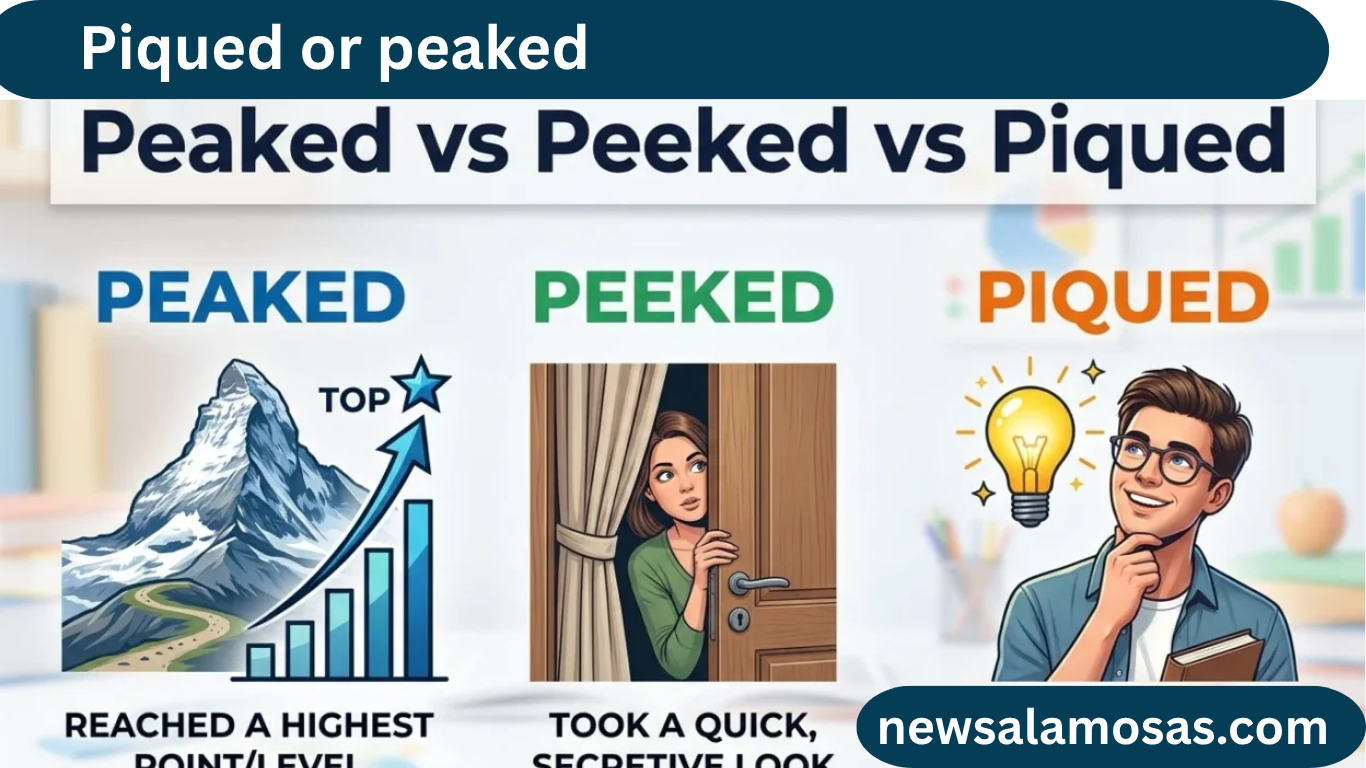
These three words are pronounced alike, but they have different meanings.
If something makes you interested or curious, the correct word is “piqued.”
If something reaches its highest level or point, the correct word is “peaked.”
If someone takes a quick look, the correct word is “peeked.”
For example:
“The article piqued my interest.”



“Sales peaked in December.”
“She peeked inside the room.”
The spelling depends on what you are trying to say.
This guide explains piqued, peaked, and peeked in simple English. It also covers common phrases such as “piqued my interest,” “pique your curiosity,” “interest has peaked,” “my interest was piqued,” and “sneak peek.”
Piqued or Peaked: Which Is Correct?
Both “piqued” and “peaked” are real English words, but they cannot normally be used in place of each other.
“Piqued” is used when something creates interest, curiosity, or attention.
“Peaked” is used when something reaches its highest point, amount, level, or stage.
Here is the easiest comparison:
| Word | Meaning | Example |
| Piqued | Made someone interested or curious | The mystery piqued my interest. |
| Peaked | Reached the highest point | Interest peaked in January. |
| Peeked | Looked quickly | She peeked through the window. |
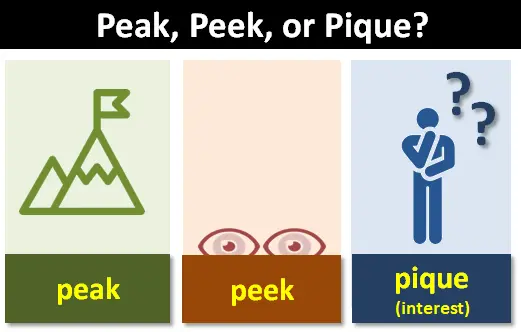
A useful way to remember them is:
Piqued = interest
Peaked = highest point
Peeked = quick look
This simple distinction solves most spelling questions involving these words.
What Does Piqued Mean?
“Piqued” is the past tense of “pique.”
When “pique” means to create interest or curiosity, “piqued” means that something made a person interested, curious, or eager to know more.
For example:
“The strange story piqued my interest.”
The story made me interested in learning more about it.
“The unusual result piqued her curiosity.”
The result made her want to understand what happened.
“The new product piqued his interest.”
The product caught his attention and made him interested.
In this meaning, “piqued” is commonly followed by words such as “interest” and “curiosity.”
Piqued Definition in Simple English
The simplest definition of “piqued” is:
Made someone interested or curious.
For example:
“The headline piqued my interest.”
This means the headline made me interested.
“The question piqued my curiosity.”
This means the question made me curious.
The word does not mean that interest reached its highest possible level. It means something caused or stimulated that interest.
That distinction is important when deciding between “piqued” and “peaked.”
What Does Pique Mean?
“Pique” is a verb that can mean to stimulate someone’s interest or curiosity.
It is often used with:
- interest
- curiosity
- attention
For example:
“The documentary piqued my interest.”
“The discovery piqued public curiosity.”
“The unusual design piqued her attention.”
The past tense is “piqued.”
So the forms are:
Pique → present
Piqued → past
Piquing → -ing form
Piques → third-person singular
Examples:
“This topic piques my interest.”
“This topic piqued my interest.”
“This topic is piquing my interest.”
Piqued My Interest: Meaning and Correct Usage
“Piqued my interest” means “made me interested.”
This is one of the most common uses of “piqued.”
For example:
“The documentary piqued my interest in wildlife.”
The documentary caused the speaker to become interested in wildlife.
Another example:
“Her explanation piqued my interest.”
Her explanation made the listener want to know more.
You can use the phrase in casual, professional, academic, and everyday writing.
For example:
“Your proposal piqued my interest.”
“The research piqued my interest in the subject.”
“That conversation really piqued my interest.”
All three examples use “piqued” correctly because something is creating interest.
Piqued or Peaked My Interest?
The correct expression is:
“Piqued my interest.”
Not “peaked my interest” when you mean “made me interested.”
For example:
Correct:
“The book piqued my interest.”
Incorrect for the same meaning:
“The book peaked my interest.”
Why is “piqued” correct?
Because the book caused the interest.
It did not reach a highest point itself.
Compare these two sentences:
“The book piqued my interest.”
“My interest in the book peaked later.”
The first sentence says the book created interest.
The second says the level of interest eventually reached its highest point.
This difference makes the two words much easier to understand.
Also read:How Streamlining Financial Processes Enhances Your Financial Operations Platform
Pique My Interest or Peak My Interest?
The correct phrase is:
“Pique my interest.”
For example:
“Does this subject pique your interest?”
“The new opportunity may pique your interest.”
“Her story piqued my interest.”
“Peak my interest” is a common spelling mistake when someone means “make me interested.”
The reason for the confusion is pronunciation. “Pique” and “peak” sound the same.
But their meanings are different.
Pique means stimulate interest.
Peak means the highest point.
Piques My Interest
“Piques” is the present-tense form used with a singular subject.
For example:
“This subject piques my interest.”
“The article piques her interest.”
“The idea piques their curiosity.”
The difference between “pique” and “piques” depends on the subject.
Compare:
“These topics pique my interest.”
“This topic piques my interest.”
The first sentence has a plural subject.
The second has a singular subject.
Piquing My Interest
“Piquing” means currently creating or stimulating interest.
For example:
“The new research is piquing my interest.”
“The discussion is piquing her curiosity.”
“The project is piquing their interest.”
This form describes an action that is happening or developing.
You may also see it in longer sentences:
“The questions raised by the study are piquing interest among researchers.”
Here, the questions are creating interest.
Piqued My Curiosity
“Piqued my curiosity” means “made me curious.”
It is especially useful when something is mysterious, unusual, surprising, or unexplained.
For example:
“The locked door piqued my curiosity.”
“The strange message piqued my curiosity.”
“The unusual photograph piqued my curiosity.”
The basic idea is always the same: something caused you to want more information.
Pique Your Curiosity
“Pique your curiosity” means to make you curious.
Also read:How Streamlining Financial Processes Enhances Your Financial Operations Platform
For example:
“The unusual title may pique your curiosity.”
“The mystery will probably pique your curiosity.”
“This question might pique your curiosity.”
The past form is:
“piqued your curiosity.”
For example:
“The strange answer piqued your curiosity.”
The difference between “pique” and “piqued” is simply the tense.
My Curiosity Is Piqued or Peaked?
When you mean that something has made you curious, the usual expression is:
“My curiosity is piqued.”
For example:
“My curiosity is piqued by the unusual results.”
This means the results have made the person curious.
However, “my curiosity peaked” can also be grammatically correct when the meaning is different.
For example:
“My curiosity peaked when I reached the final chapter.”
Here, “peaked” means curiosity reached its highest level.
So both forms can be correct, depending on the intended meaning.
Curiosity Piqued or Peaked?
This is another case where context matters.
Use “piqued” when something creates curiosity:
“The mystery piqued her curiosity.”
Use “peaked” when curiosity reaches its highest point:
“Her curiosity peaked when she discovered the hidden room.”
The difference can be understood as cause versus highest level.
Something can pique your curiosity.
Your curiosity can peak.
That is one of the easiest rules to remember.
My Interest Is Piqued or Peaked?
Both phrases are possible, but they express different ideas.
“My interest is piqued” means something has made me interested.
“My interest peaked” means my interest reached its highest level.
For example:
“My interest was piqued by the new course.”
The course made me interested.
“My interest in the course peaked after the first month.”
My interest became strongest at that point.
The word “piqued” focuses on creating interest.
The word “peaked” focuses on the maximum level of interest.
My Interest Was Piqued
“My interest was piqued” is a natural and standard expression.
It means something caused the speaker to become interested.
For example:
“My interest was piqued by the company’s new project.”
“My interest was piqued after reading the report.”
“My interest was piqued when I heard about the opportunity.”
This construction is especially useful in professional writing.
You might use it when discussing a career, product, business opportunity, research topic, or new idea.
My Interest Was Piqued When I Found Out
“My interest was piqued when I found out” is also correct.
For example:
“My interest was piqued when I found out how the system worked.”
“My interest was piqued when I found out about the new position.”
“My interest was piqued when I found out the story was based on real events.”
The phrase works because discovering new information can create curiosity.
If you mean that your interest reached its highest level after discovering something, you could instead use “peaked.”
For example:
“My interest peaked when I found out the full story.”
That sentence means the discovery brought the interest to its highest point.
What Piqued Your Interest?
“What piqued your interest?” is a common question.
It means:
“What made you interested?”
For example:
“What piqued your interest in this career?”
“What piqued your interest in the subject?”
“What piqued your interest in photography?”
“What piqued your interest in this company?”
This phrase is often useful during interviews because it asks about the reason someone became interested in a particular subject.
What Piques Your Interest?
“What piques your interest?” is similar, but it usually asks about something that interests you in general.
For example:
“What piques your interest about this field?”
“What piques your interest in this type of work?”
“What piques your curiosity about the topic?”
The word “piques” is correct because the subject is something that stimulates interest.
You’ve Piqued My Interest
“You’ve piqued my interest” means:
“You have made me interested.”
For example:
“You’ve piqued my interest. Can you explain more?”
This expression is useful when someone has mentioned something surprising or interesting.
Another example:
“You’ve piqued my interest in the project.”
The speaker is saying that the other person has caused them to become interested in the project.
The spelling “peaked” would change the meaning and would not be correct for this intended expression.
Piqued His Interest, Piqued Her Interest, and Piqued Their Interest
The same expression works with different pronouns.
Piqued his interest:
“The discovery piqued his interest.”
Piqued her interest:
“The course piqued her interest.”
Piqued their interest:
“The proposal piqued their interest.”
The structure remains the same.
Something causes the person or group to become interested.
Piqued or Peaked Interest
“Piqued interest” means interest was stimulated.
“Peaked interest” means interest reached its highest level.
For example:
“The announcement piqued interest among customers.”
The announcement created interest.
“Customer interest peaked during the first week.”
Customer interest reached its highest level during that period.
This is why the phrase “peaked interest” should not automatically be treated as wrong. It can be correct in a sentence where “peaked” means reached a maximum.
The surrounding words and intended meaning matter.
Interest Has Peaked or Piqued?
Both expressions can be correct.
“Interest has piqued” usually needs something that causes the interest, such as:
“The announcement has piqued interest.”
This means the announcement has created interest.
“Interest has peaked” means interest has reached its highest level.
For example:
“Interest in the product has peaked.”
This means the level of interest is now at its maximum or near its highest point in the situation being discussed.
Compare:
“The announcement has piqued interest.”
“Interest in the announcement has peaked.”
These are not the same statement.
Peaked Definition
“Peaked” is the past tense of “peak.”
To peak means to reach the highest point, level, amount, or stage.
For example:
“Sales peaked in December.”
This means December had the highest sales level.
“The temperature peaked at noon.”
This means noon had the highest temperature.
“Demand peaked during the summer.”
This means demand reached its highest level during the summer.
What Does Peaked Mean?
“Peaked” can describe many things that have a measurable or identifiable high point.
Also read:How Ba Insight Alfresco Integration Enhances Enterprise Content Management?
For example:
Sales can peak.
Prices can peak.
Interest can peak.
Demand can peak.
Performance can peak.
A career can peak.
A person’s popularity can peak.
A temperature can peak.
The important idea is always reaching a maximum.
For example:
“Demand peaked after the announcement.”
The sentence does not mean the announcement created demand. It means demand eventually reached its highest level after the announcement.
What Does It Mean to Peak?
To “peak” means to reach a highest point.
For example:
“Sales peaked last summer.”
“Her performance peaked during the final round.”
“Traffic peaked in the afternoon.”
“The athlete peaked at the right time.”
The noun “peak” can also mean the highest point itself.
Also read:How Ba Insight Alfresco Integration Enhances Enterprise Content Management?
For example:
“The mountain has a snowy peak.”
“The company reached the peak of its success.”
So “peak” can refer to both a highest point and the process of reaching it, depending on how it is used.
Peaking Definition
“Peaking” is the -ing form of “peak.”
It means reaching or approaching a highest point.
For example:
“Demand is peaking.”
“Interest is peaking before the event.”
“Temperatures are peaking this afternoon.”
“The athlete is peaking before the competition.”
The word is connected with maximum performance, level, amount, or intensity.
Peak vs Peek
“Peak” and “peek” sound alike, but their meanings are completely different.
Peak = highest point.
Peek = quick look.
Examples:
“The mountain peak was visible from the road.”
“I took a peek inside.”
“Demand reached its peak.”
“She peeked through the door.”
A mountain can have a peak.
A person can take a peek.
This distinction is useful when writing phrases such as “sneak peek” and “peak season.”
Peek Meaning
“Peek” means to look quickly, briefly, or sometimes secretly.
For example:
“She took a peek inside the box.”
“He peeked around the corner.”
“I peeked at the schedule.”
“They peeked through the window.”
The word is connected to looking.
It has nothing to do with reaching a highest point.
Peeked Meaning
“Peeked” is the past tense of “peek.”
It means looked quickly.
For example:
“She peeked inside the room.”
“He peeked through the curtains.”
“I peeked at the answer.”
“They peeked around the corner.”
If someone looked briefly, “peeked” is the correct word.
Peeked or Peaked?
Use “peeked” when someone looked.
Use “peaked” when something reached a highest point.
For example:
“She peeked through the window.”
“Sales peaked in June.”
The first sentence describes an action involving sight.
The second describes a maximum level.
Peaking or Peeking?
These two words have very different meanings.
Peaking = reaching the highest point.
Peeking = looking quickly.
Examples:
“The athlete is peaking before the event.”
“She is peeking through the doorway.”
“Interest is peaking.”
“He is peeking at the answer.”
A simple spelling trick is to connect “peeking” with “seeing.”
You use “peeking” when someone is looking.
Sneak Peek or Sneak Peak?
The correct expression is:
“Sneak peek.”
A “sneak peek” means a quick, early, or limited look at something.
For example:
“Here is a sneak peek of the new product.”
“The studio released a sneak peek of the film.”
“Take a sneak peek at the new collection.”
The word is “peek” because the meaning involves looking.
“Sneak peak” is a common spelling mistake.
Take a Peek or Take a Peak?
The correct phrase is:
“Take a peek.”
For example:
“Take a peek inside.”
“Can I take a peek?”
“Take a peek at this picture.”
You are taking a quick look, so “peek” is correct.
“Take a peak” would suggest taking a highest point, which does not make sense in this expression.
Peak Interest vs Pique Interest
These phrases can be confusing because both “peak” and “pique” can appear with “interest.”
But their meanings are different.
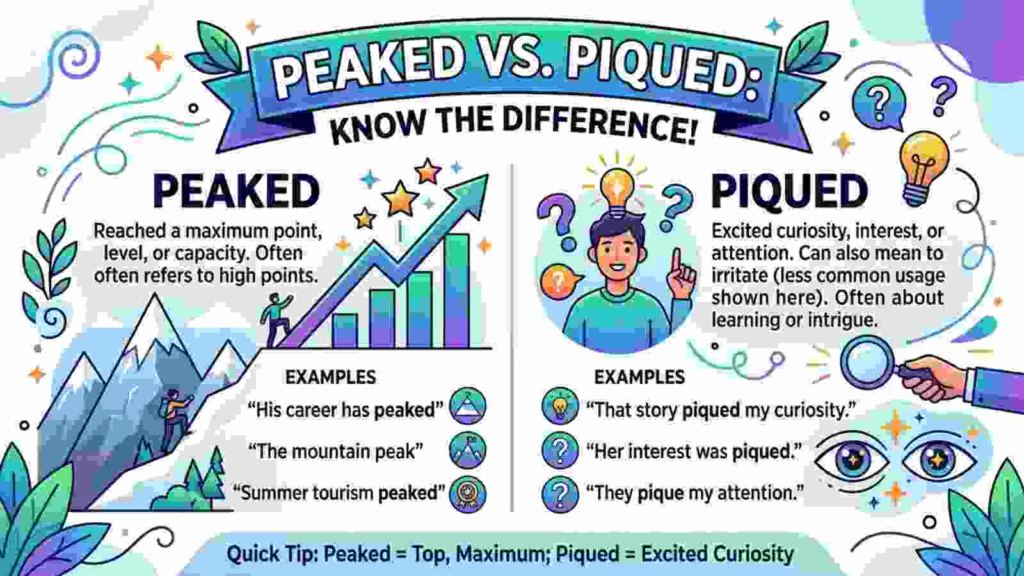
“Pique interest” means create interest.
“Peak interest” is used when discussing the highest level of interest.
For example:
“The article piqued my interest.”
The article made me interested.
“Interest peaked after the article was published.”
Interest reached its highest level.
A helpful sentence pair is:
“Something piques your interest.”
“Your interest can peak.”
Pique vs Peak vs Peek
These three words deserve a separate comparison because they are often confused.
| Word | Meaning | Example |
| Pique | Stimulate interest or curiosity | The question piqued my curiosity. |
| Peak | Highest point or level | Sales reached their peak. |
| Peek | Quick look | I took a peek inside. |
You can remember them through three questions:
Did it make you curious?
Use pique.
Did it reach the top?
Use peak.
Did someone look quickly?
Use peek.
Common Spelling Mistakes
Because these words sound identical, several mistakes appear frequently.
“Peaked My Interest”
When the intended meaning is “made me interested,” use:
“Piqued my interest.”
“Peeked My Interest”
Use “peeked” for looking, not for creating interest.
Correct:
“She peeked inside.”
Correct:
“The story piqued her interest.”
“Peak Your Interest”
The standard phrase meaning “make you interested” is:
“Pique your interest.”
“Peak My Curiosity”
When something makes you curious, use:
“Pique my curiosity.”
For example:
“The mystery piqued my curiosity.”
“Sneak Peak”
The standard phrase is:
“Sneak peek.”
It means a quick or early look.
Piqued in Professional Writing
“Piqued” can work well in professional writing when you want to explain why something attracted your attention.
For example:
“The company’s expansion plans piqued my interest.”
“The position piqued my interest because of its focus on research.”
“The proposal piqued our interest.”
The word can make professional writing sound natural without being overly complicated.
However, “made me interested” is also perfectly understandable if you want very simple language.
Piqued in Academic Writing
In academic writing, “piqued” may be useful when discussing curiosity or interest.
For example:
“The unexpected result piqued the researchers’ curiosity.”
“The findings piqued interest in further research.”
“The initial observation piqued interest in the subject.”
When writing for a formal academic audience, make sure the sentence clearly communicates whether you mean creating interest or reaching a maximum level.
Peaked in Business and Data
“Peaked” is especially common when discussing numbers and trends.
Also read:Digital Marketing Strategies: Effective Approaches for AEO vs GEO Decisions
For example:
“Sales peaked in December.”
“Traffic peaked at noon.”
“Demand peaked during the holiday period.”
“Prices peaked before falling.”
“Interest peaked after the announcement.”
In these examples, “peaked” describes a maximum point.
This is different from “piqued,” which describes something creating interest.
Piqued vs Peaked in a Sentence
Here are several side-by-side examples:
“The question piqued my interest.”
“My interest peaked during the final presentation.”
“The article piqued her curiosity.”
“Her curiosity peaked when she discovered the answer.”
“The advertisement piqued customer interest.”
“Customer interest peaked during the first week.”
Notice how both words can be used in related sentences without having the same meaning.
Piqued vs Peeked in a Sentence
Compare:
“The story piqued my interest.”
“She peeked through the window.”
“Piqued” is connected to interest.
“Peeked” is connected to looking.
They sound alike, but their meanings are unrelated.
aL
Another Word for Piqued
Depending on the context, synonyms for “piqued” can include:
Interested
Intrigued
Curious
Fascinated
Captivated
Engaged
Stimulated
Sparked
Attracted
Caught my attention
For example:
“The story piqued my interest.”
could become:
“The story intrigued me.”
“The story caught my attention.”
“The story sparked my interest.”
The best alternative depends on the exact meaning and tone.
Piqued My Interest Synonyms
If you want another way to say “piqued my interest,” you can use:
“caught my interest”
“caught my attention”
“sparked my interest”
“made me curious”
“intrigued me”
“captured my attention”
“got me interested”
For example:
“The new research piqued my interest.”
“The new research sparked my interest.”
“The new research caught my attention.”
All of these can work, but “piqued my interest” is the standard idiomatic phrase.
Piqued Pronunciation
“Piqued” is pronounced the same way as “peaked” and “peeked.”
This is one reason the spelling is difficult.
When speaking, the listener normally cannot tell which word you mean from pronunciation alone.
The surrounding context provides the meaning.
For example:
“I peeked inside.”
and
“It piqued my interest.”
sound alike in the key word, but the rest of the sentence makes the intended meaning clear.
How Do You Spell Piqued?
The correct spelling is:
P-I-Q-U-E-D
Piqued.
It comes from “pique.”
A useful way to remember the spelling is to learn the phrase as a complete unit:
“piqued my interest.”
Instead of trying to remember the spelling by sound, connect “pique” with curiosity and interest.
How Do You Spell Peaked?
The correct spelling is:
P-E-A-K-E-D
Peaked.
It comes from “peak.”
Think about the top of a mountain.
A peak is a high point.
Therefore:
Peak → peaked.
For example:
“Sales peaked in December.”
How Do You Spell Peek?
The correct spelling is:
P-E-E-K
Peek.
It means to look quickly.
For example:
“Take a peek.”
The past tense is:
Peeked.
The -ing form is:
Peeking.
So:
Peek → peeked → peeking.
A Quick Way to Choose the Right Word
When you are writing and cannot decide, stop listening to the sound and look at the meaning.
Ask yourself:
Does the sentence describe interest or curiosity?
Use “pique” or “piqued.”
Does the sentence describe a highest point?
Use “peak” or “peaked.”
Does the sentence describe looking?
Use “peek” or “peeked.”
For example:
“The mystery made me curious.”
Replace “made me curious” with “piqued my curiosity.”
“Sales reached the highest level.”
Replace “reached the highest level” with “peaked.”
“She looked quickly inside.”
Replace “looked quickly” with “peeked.”
This method is much more reliable than choosing the spelling by pronunciation.
Final Thoughts
Piqued, peaked, and peeked are easy to confuse because they sound the same, but their meanings give you a clear way to separate them.
Use “piqued” when something creates interest or curiosity.
Use “peaked” when something reaches its highest point or level.
Use “peeked” when someone looks quickly.
The most useful examples to remember are:
“Piqued my interest.”
“Interest peaked.”
“Take a peek.”
These three phrases show the basic difference very clearly.
If something makes you want to know more, your interest has been piqued.
If your interest reaches its highest level, your interest has peaked.
If you look briefly at something, you take a peek.
Once you connect each word with its meaning, phrases such as “piqued or peaked my interest,” “curiosity piqued or peaked,” “interest has peaked or piqued,” and “sneak peek or peak” become much easier to handle.
FAQs About Piqued or Peaked
Should I say “piqued my interest” or “peaked my interest”?
Use “piqued my interest” when you mean that something made you interested. For example, “The new book piqued my interest.” Use “peaked” when you mean that interest reached its highest level, as in “My interest in the subject peaked during college.”
Is “my curiosity is piqued” correct?
Yes. “My curiosity is piqued” is correct when something has made you curious. For example, “My curiosity is piqued by the unusual results.” “My curiosity peaked” can also be correct, but it means your curiosity reached its highest level.
What is the difference between pique and peak?
“Pique” means to stimulate interest or curiosity, while “peak” refers to the highest point or level. For example, “The question piqued my interest” means the question made me interested. “Sales reached their peak” means sales reached their highest level.
Is it “sneak peek” or “sneak peak”?
The correct phrase is “sneak peek.” It means a quick or early look at something. For example, “The company released a sneak peek of its new product.” “Sneak peak” is a common spelling mistake.
Is “peeked my interest” correct?
No, not when you mean that something made you interested. “Peeked” means looked quickly. The correct expression is “piqued my interest.” For example, “The unusual story piqued my interest,” while “She peeked through the window” uses “peeked” correctly.