






Writing clearly requires picking the exact right word for every situation. While the word “space” is versatile, relying on it repeatedly can make your essays, stories, or professional documents feel repetitive. A room can be spacious, a gap can be wide, and the cosmos can feel infinite. Using the specific term that fits your exact meaning makes your writing far more engaging and precise.
- What Does Space Mean? Understanding the Core Concept
- 1. Physical Room, Area, and Dimensions
- 2. Gaps, Openings, and Empty Spaces
- 3. Geographic, Regional, and Border Terms
- 4. Outer Space, Astronomy, and Cosmic Concepts
- 31. Cosmos
- 32. Firmament
- 33. Void (Cosmic)
- 34. Universe
- 35. Vacuum
- 36. Interstellar Space
- 37. Deep Space
- 38. Celestial Sphere
- 39. Milky Way
- 40. Abyss (Cosmic)
- 5. Personal, Psychological, and Abstract Space
- 41. Personal Space
- 42. Safe Space
- 43. Latitude
- 44. Scope
- 45. Margin
- 46. Elbow Room
- 47. Sanctuary
- 48. Breathing Room
- 49. Realm
- 50. Haven
- 6. Design, Architecture, and Web UI Terms
- 51. White Space
- 52. Negative Space
- 53. Layout
- 54. Margin (Design)
- 55. Padding
- 56. Clearance (Architecture)
- 57. Grid
- 58. Alignment
- 59. Proportion
- 60. Spatial Distribution
- 7. Small, Enclosed, or Confined Spaces
- 61. Alcove
- 62. Nook
- 63. Pocket
- 64. Enclosure
- 65. Cubicle
- 66. Niche
- 67. Compartment
- 68. Crawl Space
- 69. Corner
- 70. Quarters
- 8. Specific Purpose, Event, and Workspaces
- 71. Workspace
- 72. Venue
- 73. Arena
- 74. Field
- 75. Facility
- 76. Ground
- 77. Platform
- 78. Hub
- 79. Station
- 80. Complex
- 9. Action Verbs for Occupying Space
- 81. Occupy
- 82. Inhabit
- 83. Fill
- 84. Encroach
- 85. Expand
- 86. Extend
- 87. Cover
- 88. Monopolize
- 89. Pervade
- 90. Span
- 10. Describing Large, Unlimited, or Infinite Space
- 91. Vastness
- 92. Infinity
- 93. Spaciousness
- 94. Immensity
- 95. Latitude (Broad)
- 96. Boundlessness
- 97. Sweep
- 98. Broadness
- 99. Openness
- 100. Reach
- Contextual Usage Comparison Table
- How to Choose the Right Synonym for Your Context
- Frequently Asked Questions
- What is the best synonym for personal space?
- What is another word for outer space?
- What does white space mean in design and writing?
- Is “space” a noun, verb, or adjective?
- What is the difference between “room” and “space”?
- Conclusion
This comprehensive guide breaks down the definition of space, explores its various meanings across different contexts, and provides 100 distinct synonyms categorized by how they are actually used in everyday English.
What Does Space Mean? Understanding the Core Concept
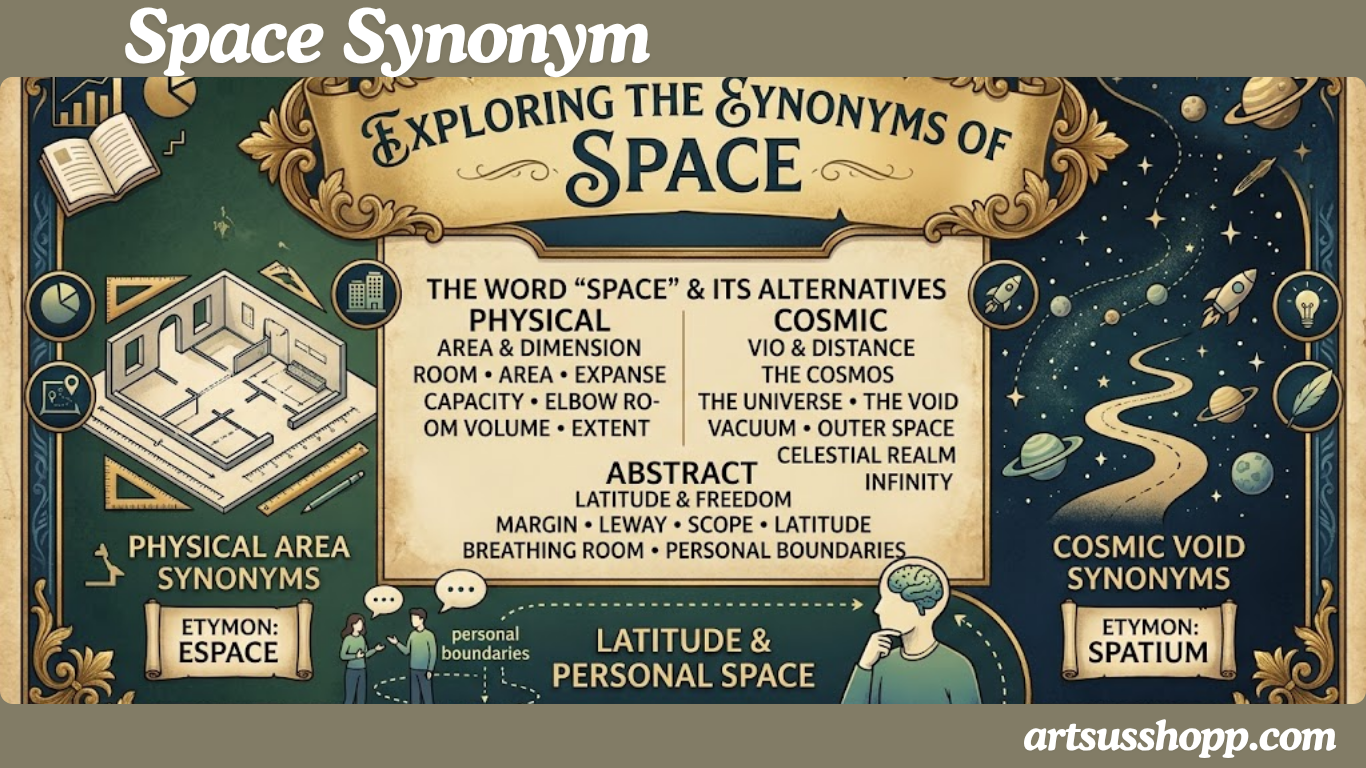
To select the best alternative word, it helps to understand the foundational definition of space. Etymologically derived from the Old French espace and Latin spatium, the term refers to a continuous area or expanse that is free, available, or unoccupied.
In English grammar, space can function as multiple parts of speech:
- Noun: A physical area, time interval, or the infinite cosmos (e.g., “There is enough space in the trunk.”).
- Verb: To position items at set distances from one another (e.g., “Space the chairs two feet apart.”).
- Adjective: Related to outer space or spatial layout (e.g., “a space mission” or “space planning”).
Depending on the context, space can refer to physical dimensions, emotional boundaries, cosmic expanse, or visual design elements.

1. Physical Room, Area, and Dimensions
When describing a physical environment, physical capacity, or three-dimensional volume, these terms specify the exact nature of an open or occupied location.
1. Room
The required unoccupied capacity needed to fit an object or person comfortably.
- Example: Clear the table so we have enough room for the project materials.
2. Area
A bounded piece of land, a specific surface, or a distinct section within a building.


- Example: The dining area opens directly into the main living room.
3. Expanse
A wide, continuous stretch of land, water, or sky without interruptions.
- Example: The airplane flew high above the vast expanse of the Pacific Ocean.
4. Volume
The total three-dimensional quantity of space occupied by a liquid, solid, or gas.
- Example: The container holds a volume of five liters.
5. Capacity
The maximum amount or number that a physical location can hold.
- Example: The conference hall was filled to maximum capacity during the keynote address.
6. Extent
The physical distance, size, or full length that a surface covers.
- Example: From the hilltop, we could see the full extent of the valley below.
7. Clearance
The explicit distance or overhead room needed for objects to pass each other safely.
- Example: The delivery truck required extra clearance to clear the low highway bridge.
8. Breadth
The physical measurement or distance from one side of an object to the other.
- Example: The carpenters measured the exact breadth of the doorway before ordering the frame.
9. Footprint
The specific ground area that a building, furniture item, or structure occupies.
- Example: The new office desk features a compact footprint ideal for smaller study rooms.
10. Spread
An expansive, open stretch of land, property, or continuous terrain.
- Example: The family farm sits on a multi-acre spread surrounded by wooden fences.
2. Gaps, Openings, and Empty Spaces
These words describe voids, breaks, intervals, or missing sections between physical structures.
11. Gap
An unfilled opening, break, or space separating two solid objects.
- Example: A small gap between the door and the frame allowed a cold breeze inside.
12. Void
A completely empty, unoccupied opening or missing section within a space.
- Example: Construction workers filled the deep void in the pavement with concrete.
13. Cavity
A hollow, empty space inside a solid body or structure.
- Example: Birds built a nest inside the hollow cavity of the oak tree.
14. Opening
An unobstructed hole, passage, or clear area allowing entry or view.
- Example: We found a narrow opening in the stone wall and walked through.
15. Slot
A narrow, precise position or opening meant to receive a specific item.
- Example: Insert the keycard directly into the designated slot to unlock the entrance.
16. Blank
An unmarked, clear, or empty section on a document or surface.
- Example: Please fill in the blank at the bottom of the registration form.
17. Interval
The distance or time step separating two distinct points or objects.
- Example: Plant the garden seeds at a six-inch interval for optimal growth.
18. Fissure
A narrow crack, split, or long opening caused by structural pressure or geological movement.
- Example: Steam escaped through a small fissure in the volcanic rock.
19. Crevice
A small, narrow opening or crack found on hard surfaces like rocks or walls.
- Example: Small green plants managed to grow out of every crevice in the stone cliff.
20. Aperture
A physical hole, gap, or adjustable opening that regulates light or passage.
- Example: The camera’s aperture widened to let in light for the evening photo.
3. Geographic, Regional, and Border Terms
Use these synonyms when describing designated territories, administrative boundaries, or land sections.
21. Zone
A designated section set aside for a unique, structured purpose.
- Example: Vehicles must obey lower speed limits when driving through a school zone.
22. District
An administrative division or neighborhood known for specific activities.
- Example: The historic district features centuries-old brick buildings and cobblestone paths.
23. Territory
A defined geographical region under the control or ownership of a group or nation.
- Example: The forest reserve represents a protected territory for native wildlife.
24. Sector
A distinct subdivision of a larger geographic area, economy, or facility.
- Example: Emergency crews scanned the northern sector of the town after the storm.
25. Region
A large land section defined by natural, cultural, or administrative characteristics.
- Example: The mountain region experiences heavy rainfall during early spring.
26. Domain
A territory or realm owned, governed, or controlled by an individual or organization.
- Example: The private estate felt like its own independent domain.
27. Quarter
A specific section or district within a city or town with distinct characteristics.
- Example: Tourists love visiting the art quarter to explore local galleries and cafes.
28. Plot
A small, measured piece of land intended for building or gardening.
- Example: They purchased a small plot of land near the lake to construct a cabin.
29. Tract
An extended area of land or water with defined boundaries.
- Example: The state acquired a large tract of forest land to establish a public park.
30. Site
The precise physical place where a building, event, or project is located.
- Example: The crew cleared the construction site before laying the foundation.
4. Outer Space, Astronomy, and Cosmic Concepts
When writing about astrophysics, deep space, celestial bodies, or the universe, these terms offer rich, context-driven alternatives.
31. Cosmos
The entire ordered, harmonious universe considered as a structured whole.
- Example: Astronomers use deep-space telescopes to map distant corners of the cosmos.
32. Firmament
The vast, visible vault of the sky or deep outer space overhead.
- Example: Thousands of brilliant stars shone brightly across the night firmament.
33. Void (Cosmic)
The vast, cold regions of deep space containing almost no matter or stars.
- Example: Space probes travel through the silent void between solar systems.
34. Universe
All existing matter, energy, galaxies, and physical space combined.
- Example: Physicists study cosmic background radiation to understand how the universe expanded.
35. Vacuum
A region of space devoid of atmospheric matter, gas, or air pressure.
- Example: Specialized equipment protects astronauts from the airless vacuum of space.
36. Interstellar Space
The physical space existing between star systems within a single galaxy.
- Example: Voyager 1 officially crossed the boundary into interstellar space.
37. Deep Space
The vast regions of space lying beyond the Earth-Moon system or solar system.
- Example: Deep space communication networks allow us to receive signals from distant probes.
38. Celestial Sphere
An imaginary sphere surrounding Earth, useful for mapping astronomical coordinates.
- Example: Ancient observers mapped star locations relative to the celestial sphere.
39. Milky Way
The spiral galaxy that contains our Solar System and billions of other stars.
- Example: On clear nights, the pale light of the Milky Way stretches across the sky.
40. Abyss (Cosmic)
An immeasurably deep or seemingly endless gulf in outer space.
- Example: Satellite arrays peer deep into the cosmic abyss to spot far-off galaxies.
5. Personal, Psychological, and Abstract Space
Space isn’t always physical. These terms express boundaries, mental freedom, emotional capacity, and interpersonal distance.
41. Personal Space
The comfortable physical or psychological distance people prefer to maintain around themselves.
- Example: Please step back slightly and respect my personal space during the conversation.
42. Safe Space
A supportive, secure environment where individuals can speak or express themselves without fear.
- Example: The community center hosts a weekly safe space group for young adults.
43. Latitude
Freedom of choice, action, or opinion within given guidelines.
- Example: The supervisor gave the team broad latitude to complete the design project.
44. Scope
The full range, extent, or boundary of topics covered by a project or discussion.
- Example: Adding extra requirements goes beyond the original scope of our contract.
45. Margin
An extra amount of physical space, time, or flexibility set aside for safety or error.
- Example: Leave a wide margin of time when driving to the airport during rainstorms.
46. Elbow Room
Adequate physical room or personal freedom to work, move, or operate comfortably.
- Example: Rearranging the office desks gave everyone more elbow room.
47. Sanctuary
A quiet, safe, or sacred place offering refuge, peace, and protection.
- Example: The home library provided a quiet sanctuary away from daily distractions.
48. Breathing Room
Sufficient physical space or time relief to recover, relax, or operate smoothly.
- Example: Lower monthly expenses gave the business enough breathing room to hire new staff.
49. Realm
A sphere of activity, interest, thought, or knowledge.
- Example: Breakthrough discoveries are happening daily within the realm of digital technology.
50. Haven
A peaceful, comfortable place that offers refuge or rest from external stress.
- Example: The shady backyard garden served as a peaceful haven during hot summer days.
6. Design, Architecture, and Web UI Terms
In graphic design, architecture, web development, and publishing, spatial terms carry specialized technical definitions.
51. White Space
The intentionally blank, uncluttered area around text, images, or graphical elements.
- Example: Clean web design relies on generous white space to make articles easy to read.
52. Negative Space
The background area surrounding the main subject in visual art, photography, or typography.
- Example: The artist used negative space cleverly to form the hidden shape of a tree.
53. Layout
The structural arrangement of text, visual elements, and margins on a page or screen.
- Example: The magazine editor updated the layout to highlight primary photos.
54. Margin (Design)
The unprinted, blank border space surrounding the body text on a page.
- Example: Set one-inch margins on all sides of the paper before printing.
55. Padding
The inner space added between a content element and its outer boundary or border.
- Example: Adjusting the button padding improved the clickability of the mobile interface.
56. Clearance (Architecture)
The specific distance required between structural elements to meet safety standards.
- Example: Building codes mandate explicit clearance between electrical panels and adjacent walls.
57. Grid
A framework of horizontal and vertical lines used to align content and spatial elements.
- Example: Designers rely on a twelve-column grid to maintain uniform spacing on web pages.
58. Alignment
The precise relative positioning of text, objects, or edges within a spatial layout.
- Example: Proper text alignment keeps multi-column layouts clean and readable.
59. Proportion
The harmonious spatial relationship between dimensions, shapes, and structural sizes.
- Example: The architect adjusted the height of the ceiling to keep the room in proportion.
60. Spatial Distribution
The structural arrangement or density of objects across a given two-dimensional or three-dimensional field.
- Example: Good retail planning requires effective spatial distribution of product display stands.
7. Small, Enclosed, or Confined Spaces
These words specifically describe limited, tight, bounded, or restricted locations.
61. Alcove
A small, recessed section or nook set back from a larger room.
- Example: We built custom bookshelves directly into the hallway alcove.
62. Nook
A cozy, small, enclosed corner or sheltered space within a larger room.
- Example: A small breakfast nook near the window catches beautiful morning light.
63. Pocket
A tiny, isolated, or self-contained space that differs from its surrounding environment.
- Example: We found a small pocket of dry ground under the dense forest canopy.
64. Enclosure
A fully bounded or fenced area designed to keep things contained or protected.
- Example: The zoo built a spacious, natural enclosure for the rescue animals.
65. Cubicle
A small, partially enclosed workspace separated by temporary partition walls.
- Example: Each cubicle in the office comes equipped with an adjustable desk.
66. Niche
A shallow, ornamental recess in a wall designed to display statues, art, or items.
- Example: A ceramic vase sat inside the decorative wall niche.
67. Compartment
A distinct, enclosed section or storage space within a structure or vehicle.
- Example: Store small travel accessories in the overhead storage compartment.
68. Crawl Space
A narrow, low unconditioned area beneath a floor or roof providing access to pipes or wiring.
- Example: The plumber checked the crawl space beneath the house to locate the water leak.
69. Corner
The specific inner space formed where two converging walls or surfaces meet.
- Example: Place the floor lamp in the far corner of the living room.
70. Quarters
Specific, often tight living accommodation or lodgings provided for personnel or guests.
- Example: Ship workers returned to their living quarters after completing their daily shifts.
8. Specific Purpose, Event, and Workspaces
Use these terms when describing areas organized around a specific task, function, assembly, or industry.
71. Workspace
A functional area, desk, or room designated specifically for doing work or studying.
- Example: Keep your home workspace clean and organized to improve daily focus.
72. Venue
The precise commercial or public location chosen for hosting events, concerts, or meetings.
- Example: The downtown theater served as the ideal venue for the annual conference.
73. Arena
A central, open space or enclosed stadium designed for sporting matches and public events.
- Example: Thousands of cheering fans gathered inside the sports arena.
74. Field
A broad, open area of land used for agriculture, sports, or specialized industrial work.
- Example: The soccer players stepped onto the green field for evening practice.
75. Facility
A purpose-built structure, building, or complex designed for specific operational services.
- Example: The modern medical facility provides urgent care services to local residents.
76. Ground
An area of land set aside and prepared for a dedicated activity, construction, or event.
- Example: The school fair ground was packed with rides, food stalls, and games.
77. Platform
A raised, flat open surface or designated area for supporting equipment or speakers.
- Example: The speaker stepped onto the platform to address the audience.
78. Hub
A central, active point or location where activities and connections come together.
- Example: The main airport terminal acts as a major transportation hub.
79. Station
A fixed, dedicated location equipped for specific work tasks, operational duties, or transit.
- Example: Each worker remains at their assigned assembly station during the shift.
80. Complex
A connected group of related buildings, facilities, or spaces serving a shared purpose.
- Example: The new sports complex includes indoor pools, gym facilities, and tennis courts.
9. Action Verbs for Occupying Space
When writing about how people, objects, or ideas interact with or consume physical area, these action verbs provide clarity.
81. Occupy
To take up, inhabit, or fill a specific physical location or volume.
- Example: Large wooden bookshelves occupy the entire back wall of the office.
82. Inhabit
To live in, reside in, or occupy a particular geographic area or structure naturally.
- Example: Native bird species inhabit the dense trees along the riverbank.
83. Fill
To make a space completely full or occupy all available capacity within a region.
- Example: Warm sunlight began to fill the room as morning broke.
84. Encroach
To gradually advance upon or take up space beyond established boundaries.
- Example: Suburban neighborhoods continue to encroach upon native forest habitats.
85. Expand
To increase in physical size, surface area, volume, or spatial coverage.
- Example: Metals tend to expand when heated to high temperatures.
86. Extend
To stretch out, lengthen, or cover a continuous physical distance.
- Example: The garden fence extends all the way down to the property line.
87. Cover
To spread over, overlay, or occupy a specific surface area completely.
- Example: Wildflowers cover the entire hillside during early spring.
88. Monopolize
To dominate, take over, or consume all available space or attention exclusively.
- Example: The large conference table monopolized most of the room.
89. Pervade
To spread thoroughly throughout every part of an open or enclosed area.
- Example: The rich smell of fresh coffee pervaded the entire morning kitchen.
90. Span
To reach across, bridge, or cover a physical space from one end to another.
- Example: The historic suspension bridge spans the entire width of the river.
10. Describing Large, Unlimited, or Infinite Space
When your goal is to convey immense scale, vast distances, or unconstrained size, reach for these adjectives and descriptive nouns.
91. Vastness
An immense, boundless, or enormous extent of physical space or geographic land.
- Example: The sheer vastness of the open desert left the travelers awestruck.
92. Infinity
An unlimited, endless, or unmeasurable extent of space or time.
- Example: Staring through a telescope makes you appreciate the infinity of the universe.
93. Spaciousness
The comfortable quality of having plenty of physical room, capacity, or floor space.
- Example: High ceilings and open windows give the living room a sense of spaciousness.
94. Immensity
The state or quality of being exceptionally large, massive, or broad in scale.
- Example: The immensity of the canyon walls made the climbers look tiny.
95. Latitude (Broad)
Unrestricted, wide-open scope or spacious freedom to move across an area.
- Example: The wide valley offered broad spatial latitude for cattle grazing.
96. Boundlessness
The quality of having no visible edges, limits, borders, or clear end points.
- Example: Looking out at the ocean horizon conveys a feeling of boundlessness.
97. Sweep
A long, continuous, and sweeping curve or expanse of land, sky, or coastline.
- Example: A majestic sweep of sandy beach stretched along the coast for miles.
98. Broadness
The quality of being wide, expansive, or extended from side to side.
- Example: The broadness of the avenue easily accommodated four lanes of traffic.
99. Openness
The state of being clear, unconfined, free of barriers, or uncluttered.
- Example: Removing internal partitions created a wonderful sense of openness.
100. Reach
The total distance or continuous stretch over which a space or influence extends.
- Example: The far reaches of the national park remain largely unexplored by visitors.
Contextual Usage Comparison Table
To help you pick the right word quickly, this table compares popular synonyms across common writing contexts:
| Synonym | Primary Meaning | Best Context / Writing Style | Example Usage |
| Room | Unoccupied capacity for fitting something | Everyday writing, conversations, essays | “Make room for the desk.” |
| Void | Complete, empty hole or missing area | Descriptive fiction, technical writing | “A missing brick left a void.” |
| Cosmos | The ordered, structured universe | Science, astrophysics, astronomy | “Mapping distant parts of the cosmos.” |
| Zone | Set-aside area with a special purpose | Business, city planning, legal docs | “A quiet zone in the library.” |
| White Space | Empty background surrounding visual design | Web design, UI design, formatting | “Use generous white space on screens.” |
| Latitude | Freedom of choice, action, or movement | Professional memos, personal growth | “Management allowed wide latitude.” |
| Enclosure | Fully bounded or fenced physical area | Property management, biology | “The animals stayed in their enclosure.” |
How to Choose the Right Synonym for Your Context
Selecting the best substitute for “space” depends entirely on what aspect of the area you want to highlight. Ask yourself these three simple questions before choosing a word:
- Is the area physical, digital, or abstract?
- If physical, use terms like room, area, clearance, or footprint.
- If digital or visual, choose white space, negative space, padding, or layout.
- If abstract, opt for scope, latitude, breathing room, or realm.
- Is the space empty, bounded, or infinite?
- Unoccupied or missing sections require words like gap, void, cavity, or slot.
- Clearly bounded locations fit words like zone, district, plot, or enclosure.
- Scale-focused or unbounded descriptions benefit from expanse, vastness, cosmos, or infinity.
- What is the tone of your piece?
- Academic or technical writing prefers precise terms (volume, aperture, capacity, spatial distribution).
- Creative or narrative prose thrives on atmospheric words (nook, sanctuary, haven, fissure).
Frequently Asked Questions
What is the best synonym for personal space?
The most accurate synonyms for personal space are breathing room, elbow room, personal boundary, and comfort zone. In psychological contexts, it is often described simply as interpersonal distance or spatial boundary.
What is another word for outer space?
Common alternatives for outer space include the cosmos, the universe, deep space, the void, interstellar space, and the firmament.
What does white space mean in design and writing?
In visual design, graphic arts, and web layout, white space (also known as negative space) refers to the unmarked, blank areas around text blocks, graphics, and buttons. It improves readability and keeps page designs uncluttered.
Is “space” a noun, verb, or adjective?
“Space” can function as all three:
- As a noun: “There is an open space over there.”
- As a verb: “Space the columns evenly across the page.”
- As an adjective: “She works in space exploration.”
What is the difference between “room” and “space”?
While often interchangeable, space usually refers to a physical expanse or dimension in general, whereas room specifically implies available or sufficient capacity required to fit something without overcrowding.
Is Master Guide to Synonyms for Space: 100 Precise Words for Every Context article ke liye yahan ek clear, SEO-friendly aur professional Conclusion hai:
Conclusion
Mastering synonyms for “space” is one of the quickest ways to elevate your writing from repetitive to precise and impactful. Whether you are crafting an academic essay, designing a clean web layout, describing the vast cosmos, or writing a business proposal, selecting the exact term—such as latitude, clearance, white space, or expanse—ensures your message is communicated with maximum clarity.
By understanding the distinct nuances across physical, geographic, cosmic, and abstract contexts, you can seamlessly adapt your vocabulary to suit any audience or format. Keep this guide bookmarked as a handy reference, and start integrating these 100 precise terms into your daily writing to enhance readability, boost SEO performance, and engage your readers effectively.